

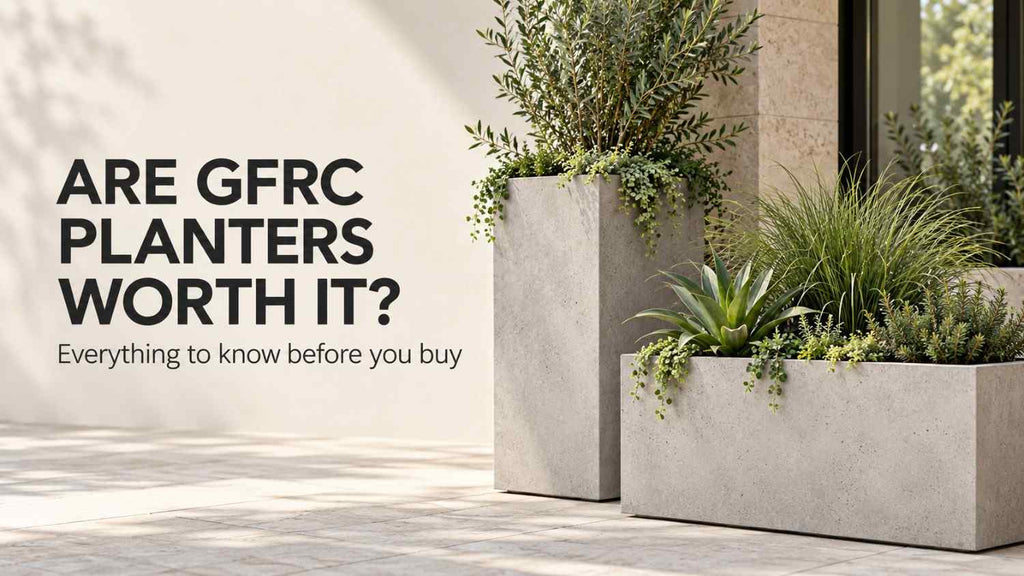
Are GFRC Planters Worth It? Everything You Need to Know Before You Buy
At some point in any serious outdoor planter search, GFRC comes up. So does the price. And the natural question is whether the material actually justifies what you're paying, or whether you're mostly paying for something that sounds technical.
Here's the honest answer: yes, GFRC planters are worth it for specific buyers and specific situations. They're not universally the right call. This guide covers what the material actually is, what it handles well, where it has limits, and who genuinely benefits from it.
River Art Stone has worked with GFRC since 2008, originally producing architectural facade cladding systems and 3D wall panels for construction projects. The planter and bathtub range came later, built on the same material knowledge and production methods. That background matters: the techniques behind the planters are the same ones used in exterior architectural applications, not adapted from decorative pottery manufacturing.
What does GFRC stand for?
GFRC is Glass Fiber Reinforced Concrete, a composite of a cement-based mix and alkali-resistant glass fibers. The fibers are the part that matters. Standard concrete depends on mass for structural integrity, which creates thick, unwieldy pieces at any real scale. The glass fiber matrix distributes tensile strength differently, letting manufacturers cast thin-walled forms that would fracture immediately in plain concrete.
What you end up with is something that reads, looks, and weathers like solid concrete while weighing considerably less and holding up better over time.
How is GFRC different from regular concrete?
Regular concrete is straightforward: the more of it there is, the stronger it is. That logic works for driveways and building foundations. For planters, it becomes a real problem quickly a plain concrete planter at a useful size can easily push 200 to 400 lbs, and at that weight, installation stops being a homeowner project.
GFRC solves this by replacing mass with fiber reinforcement. A large GFRC planter at the same dimensions as a solid concrete equivalent typically comes in 60 to 70% lighter. Something that would weigh 300 lbs in solid concrete lands at 80 to 120 lbs in GFRC. That gap matters practically it's the difference between a freight delivery with a crew and two people with a hand truck.
Are GFRC planters durable outdoors?
Yes, and this is where the price actually makes sense. GFRC is frost-resistant and UV-stable, which means it handles the freeze-thaw cycling that destroys terracotta and cheaper concrete in colder climates. A well-made piece doesn't need to come inside in October, get wrapped, or get sealed before winter. It stays out year-round.
Realistic lifespan for a quality piece in outdoor use is 20 to 30 years. The surface doesn't chalk, peel, or fade the way resin and fiberglass do. On textured and antique-finish pieces, outdoor aging actually adds to the surface rather than working against it.
A quick look at the alternatives:
Terracotta and ceramic are beautiful materials, but they crack in frost. Without a covered storage space or climate-controlled garage, they're not four-season options in most of the US. Resin and fiberglass cost less upfront, but UV degradation shows within two to four years outdoors — the finish that convincingly mimics stone at purchase starts looking off. Solid concrete is genuinely durable, but the weight makes it impractical for anything beyond ground-level permanent installation. Natural stone is excellent when it's dense and properly sealed, though porous stone in a cold climate is a gamble and ongoing maintenance is real.
GFRC removes more of those risk factors than any comparable material at a similar price point.
Do GFRC planters need any maintenance?
No sealing schedule. No annual treatment. No coating to refresh. Rinse them off when they look dirty. That's it.
For commercial properties, hotels, and anyone managing multiple outdoor spaces, this isn't a minor detail; it's a meaningful cost difference over five or ten years. Most decorative outdoor materials eventually need something. GFRC largely doesn't.
Are GFRC planters good for large trees and specimen plants?
This is actually one of the main reasons buyers choose the material. If you're putting a mature olive tree, a large ornamental grass, or a specimen succulent on a rooftop, terrace, or elevated deck, you need root volume and structural load to work together. GFRC is one of the few materials that lets them.
At 80 to 120 lbs unfilled, a large GFRC planter can go on most well-built decks without triggering structural concerns. A stone equivalent at 300-plus lbs often can't. Once you're adding soil, a root ball, and water, that starting weight difference has a real impact on what's feasible.
The Mondo Planter at River Art Stone is built specifically for this use of a wide-mouth form that gives established root systems room rather than forcing them to circle. The Hayyo handles commercial exteriors and contemporary residential settings where the geometry has to work architecturally, not just functionally.
What finishes are available in GFRC planters?
Two broad categories cover most of what's available.
Modern finishes run toward smooth or lightly textured surfaces in grays, blacks, and neutral tones. They suit contemporary architecture, concrete paving, composite decking, and steel or glass exteriors well. The Faddo Planter in matte black is a good reference point — the GFRC surface produces a depth that molded resin in the same color can't match.
Antique finishes are hand-cast with tonal variation and aged surface texture that develops character rather than degrading with outdoor exposure. These belong in formal gardens, period properties, and settings with traditional stone or brick. The Gobeklitepe works this way — the surface variation comes from the casting process itself, not from a uniform mold treatment.
The thing that separates GFRC from cheaper alternatives is that both finishes hold over time. The modern surfaces don't go chalky. The antique finishes don't start looking like cast resin after a couple of seasons outdoors.
Can GFRC planters go on a rooftop or elevated deck?
Generally yes, but with one thing to verify first. GFRC's weight advantage is real, but a large planter filled with soil and a mature plant can still weigh 150 to 300 lbs total. Deck and terrace load ratings vary considerably, and you want to confirm yours can handle it before installation — that's true for any heavy planter, not specifically a GFRC concern.
At ground level, there's nothing to worry about. GFRC planters go directly on patios, gravel, paved surfaces, and grass without any special preparation.
Are GFRC planters worth it for commercial use?
Particularly yes. Hotels, restaurants, office buildings, and retail properties all deal with the same basic problem: outdoor planters that look good at installation and need work or replacement within a few years. GFRC's durability without maintenance fits commercial timelines better than most alternatives. The material holds up to daily exposure, doesn't need seasonal attention, and typically looks better at year five than comparable materials do at year two.
Weight matters commercially too. Specifying large GFRC planters for a hotel entrance or terrace sidesteps a lot of the structural mitigation that solid stone would require.
How much do GFRC planters cost and is it worth the price?
GFRC planters sit above resin and fiberglass on price and are roughly comparable to quality stone. The cost reflects the casting process, material quality, and longevity.
Whether it's worth it depends on what you're comparing it to. If you're replacing resin planters every three or four years, a decade of replacement costs almost certainly exceeds what GFRC costs once. Against cheap terracotta, the upfront number is higher but the replacement cycle and climatic limitations close the gap faster than most buyers expect.
River Art Stone planters range from $389 for medium forms like the Lamus and The Egg up to $1,899 for larger statement pieces like the Enginar. All orders ship free anywhere in the US — worth factoring in when comparing to other suppliers who charge freight on heavy pieces.
For anyone treating outdoor planters as a permanent part of a designed space rather than seasonal filler, GFRC makes sense. For someone who wants inexpensive color that changes every year, it's probably not the right fit.
Does River Art Stone ship GFRC planters across the US?
Yes. Free shipping on all orders, anywhere in the US.
So, Is It Worth It?
GFRC planters are worth buying if you're outfitting an outdoor space for the long term, installing something on a rooftop or elevated deck, need large-scale planting with manageable weight, or want a commercial-grade material that won't need seasonal attention. They're not worth it if you're furnishing a temporary space or planning to refresh things every few years anyway.
The material outperforms the alternatives on the things that actually matter outdoors: freeze-thaw resistance, UV stability, weight-to-strength ratio, and lifespan. That's what the price reflects.
Related post
21
Oct
River Art Stone News & Blogs
Are GFRC Planters Worth It? Everything You Need to Know Before You Buy
Read more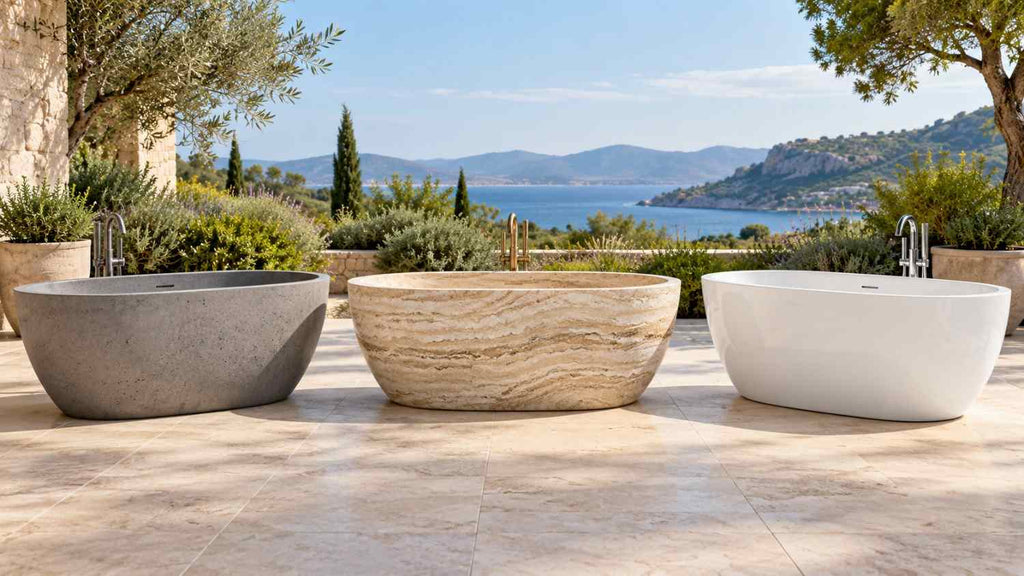
21
Oct
River Art Stone News & Blogs
Concrete Bathtub vs Stone vs Acrylic: Which One Actually Lasts Outdoors?
Read more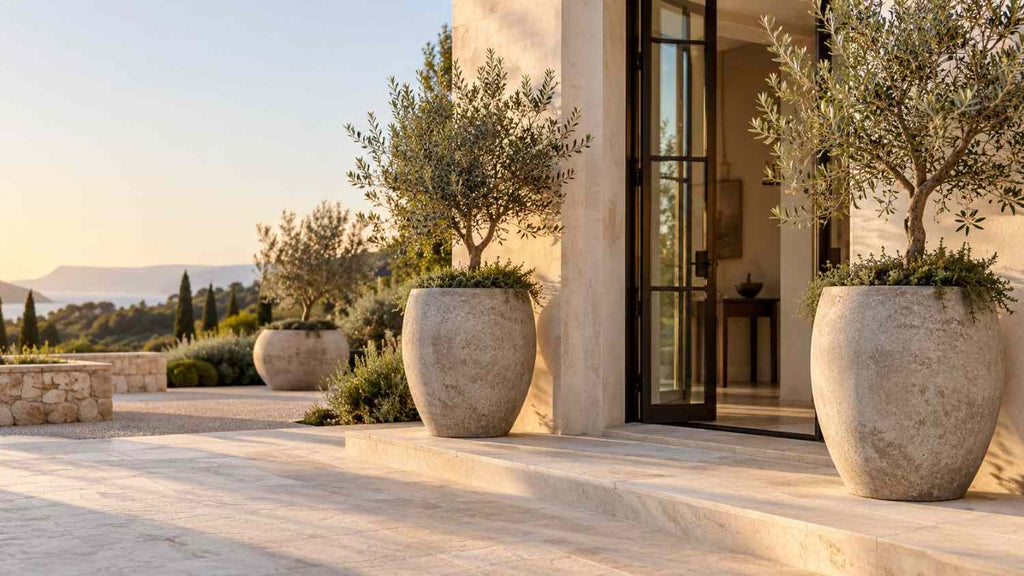
20
Oct
River Art Stone News & Blogs
Best Extra Large Outdoor Planters for Trees, Entryways & Statement Spaces (2026 Guide)
Read more
21
May

25
Mar


