

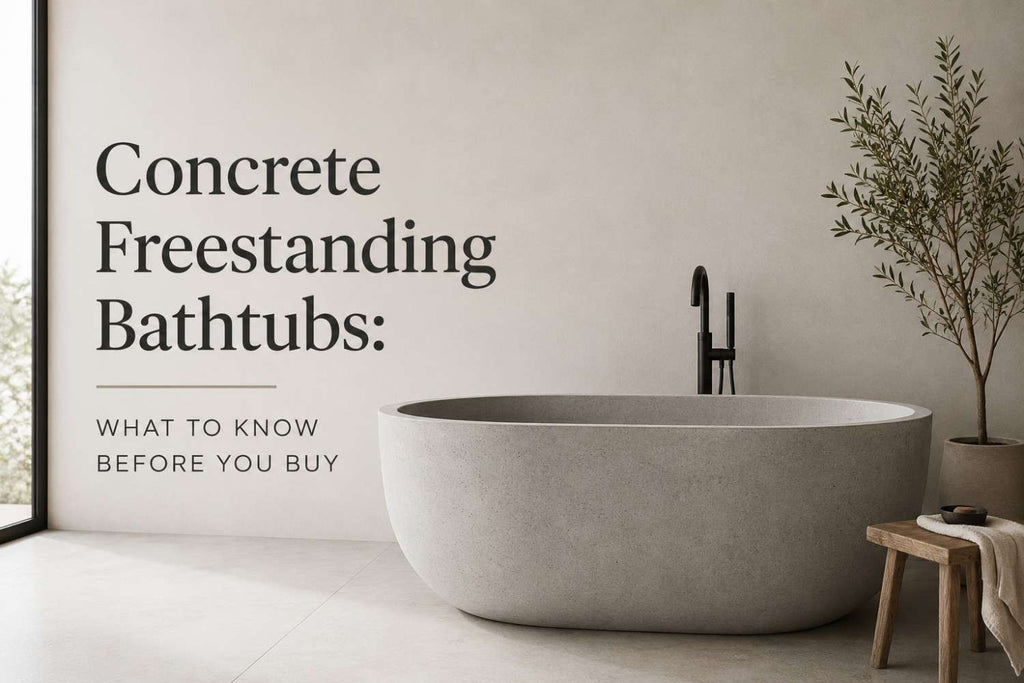
Concrete Freestanding Bathtubs: What to Know Before You Buy
You've seen them in hotel suites and high-end home tours, that thick sculptural tub sitting in the middle of a bathroom like it was poured there, with a matte finish, no visible seams, and none of the glossy plastic quality that acrylic brings. Now you're wondering if it works in your bathroom, and more practically, how it actually works, because the articles you've read so far either stay too shallow or circle back to acrylic comparisons you didn't ask for.
This guide covers what actually matters before you buy a concrete freestanding bathtub.
What "Concrete Bathtub" Actually Means
Not all concrete freestanding bathtubs are made the same way, and the difference affects everything from installation complexity to how the tub performs over the long term.
Poured concrete tubs are built on-site by specialist contractors, custom and beautiful but labor-intensive, with a curing process that takes time and a surface that needs regular sealing to stay watertight. For a fully bespoke built-in installation it's a legitimate path. For a freestanding tub you want delivered and installed without a multi-week construction window, it's not practical for most homeowners.
GFRC, which stands for Glass Fiber Reinforced Concrete, is what most people are actually buying when they search for a concrete freestanding bathtub. It's manufactured in a controlled production environment where alkali-resistant glass fibers are mixed into the concrete composite to increase strength while reducing weight. The surface comes out of production already finished and non-porous, so there's no on-site curing required and no annual sealing to maintain.
River Art Stone has been producing GFRC since 2008, starting with architectural facade cladding and building panels before expanding into bathtubs in 2019 using the exact same production methods and material standards. A company that spent over a decade engineering GFRC for building exteriors approaches a luxury bathtub differently than one that started in bathroom products, and that difference shows in the finished piece.
| How to Choose the Right Concrete Freestanding Bathtub (Dimensions, Shapes & Design Guide)
Sort Out the Weight Question Before You Order
Weight is where bathroom renovations get complicated and costs catch people off guard.
Standard acrylic freestanding tubs weigh between 70 and 100 pounds, light enough that two people can maneuver one into place without much trouble. A concrete freestanding bathtub runs between 200 and 350 pounds depending on size and wall thickness, and when you add water and a person, the total load concentrated on one area of your floor can exceed 1,000 pounds.
If you're on a ground floor with a concrete slab, you're almost certainly fine and don't need any structural work before ordering. If you're on an upper floor with a wood-framed structure, it's worth having your contractor check the floor beams beneath the bathroom before you place any order. In newer construction this is usually a non-issue. In newer construction this is usually a non-issue. In pre-1980s homes you may need the joists reinforced, which adds cost but is not a complex job when you know about it before the tub arrives rather than after.
GFRC is considerably lighter than site-poured concrete at equivalent sizes, which is one of the main reasons architects and interior designers specify it for rooftop bathrooms, elevated terraces, and upper-floor master suites where structural load is a genuine constraint. You get the full visual weight and presence of a concrete freestanding tub without the structural burden that raw poured concrete would create.
Heat Retention Is One of the Best Reasons to Choose Concrete
Concrete holds heat, and this is the same thermal mass property that makes concrete floors slow to warm in winter and concrete walls effective at keeping interiors cool through a hot afternoon in Arizona or Texas.
In a deep soaking tub, thermal mass translates to water that stays at temperature significantly longer than it does in an acrylic or fiberglass tub. For a 20-minute bath the difference is minor, but for a 45-minute soak it's the kind of difference you notice every single time you use the tub, because you're not reaching for the hot tap halfway through.
The one adjustment worth knowing about upfront is that a concrete freestanding bathtub takes longer to warm up from cold than acrylic does, so your first fill of the day benefits from running a few degrees hotter than you normally would. Most people stop thinking about it within the first week because it becomes part of how the tub works rather than a problem to manage.
The Finish and Color Decision Is More Permanent Than Most People Realize
River Art Stone's GFRC bathtubs use a matte architectural finish that is smooth to the touch, visually quiet, and has a material depth that high-gloss acrylic simply doesn't replicate. It works in minimalist white bathrooms, in warm organic interiors, and in the kind of indoor-outdoor spa designs that have become increasingly common in luxury homes across California, Florida, and the Southwest.
The color decision deserves more thought than most buyers give it, because with GFRC it is genuinely permanent in a way that painted or coated surfaces are not. Pigment is mixed directly into the concrete during production at our facility in Antalya, Turkey, not applied as a surface coating afterward, which means the color runs through the material from surface to core. There is no finish layer to chip, fade, peel, or wear through over years of daily use, and what you choose at the time of order is what the tub looks like in 15 years.
White and light grey are the most commonly specified finishes for modern and minimalist bathroom designs. Warmer earth tones work well in desert-influenced interiors and organic material palettes. Black makes a strong visual statement in high-contrast bathroom designs. Custom color matching is available for hospitality projects and residential specifications where matching a precise interior scheme matters more than choosing from a standard range.

Sizing Is Where Most Buyers Make the Wrong Call
Concrete freestanding bathtubs are designed to anchor a room, and they need sufficient space around them to do that effectively.
Choosing a tub size that works with your bathroom proportions makes a significant difference to how the finished room looks and feels. Before committing to a specific model, measure your usable floor space carefully and allow for a minimum of 24 inches of clear floor on each side you access the tub from, with more room behind the tub if your layout allows.
For large master bathrooms, open spa layouts, and outdoor bathroom installations, a longer tub with a strong sculptural silhouette is almost always the better choice over a more compact model. The Cappadocia oval at 71 inches is built specifically for rooms that can hold a centerpiece, with a deep soaking profile and a sculptural edge that reads differently from every angle of the room. The Gordion takes a vertical approach, taller and narrower in form, designed for spaces where floor area is limited but the architecture gives you ceiling height to create a vertical statement instead.
If you're genuinely unsure between two sizes, go with the larger one. In a generous space an undersized concrete freestanding bathtub is a daily reminder of the wrong decision, and it's not a mistake you can easily fix after installation.

Outdoor Installations: Why Concrete Is One of the Few Materials Actually Built for It
Most freestanding tub materials are specified for indoor use and tolerated outdoors at best. Acrylic fades with sustained UV exposure and acrylic freestanding tubs were never engineered for what outdoor environments deliver year after year across climates like Florida humidity, Arizona heat, or coastal California salt air.
GFRC comes from a building products background where UV stability, freeze-thaw resistance, and long-term moisture performance are baseline requirements rather than optional features. River Art Stone's GFRC bathtubs carry a Class A1 fire rating, which is the internationally recognized classification for the highest level of fire resistance in building materials, the same standard required for commercial building facades.
For covered outdoor bathrooms, rooftop spa installations, pool-adjacent soaking areas, and the indoor-outdoor bathroom designs that have become a defining feature of luxury homes across Texas, Arizona, Florida, and coastal California, a concrete freestanding bathtub is one of the very few choices that looks genuinely intentional rather than improvised.
Some Bathrooms Are Designed. Others Are Just Installed.
Before you order, run through these three things:
- Establish your floor structure situation, especially if you're on an upper floor with wood framing
- Measure your bathroom dimensions with clearance in mind before committing to a model
- Decide on finish and color early, because those decisions don't get revisited easily once the order is placed
River Art Stone's concrete bathtub collection includes full-size deep soaking tubs available in multiple finishes with custom dimensions available for both residential and commercial hospitality projects. Our production facility in Antalya, Turkey has been working with GFRC since 2008, and the same material knowledge and production standards that built our architectural cladding business go into every bathtub we make.
Browse the concrete freestanding bathtub collection or request a quote directly.
Related post
21
May

25
Mar
River Art Stone News & Blogs
How to Choose the Right Concrete Freestanding Bathtub (Dimensions, Shapes & Design Guide)
Read more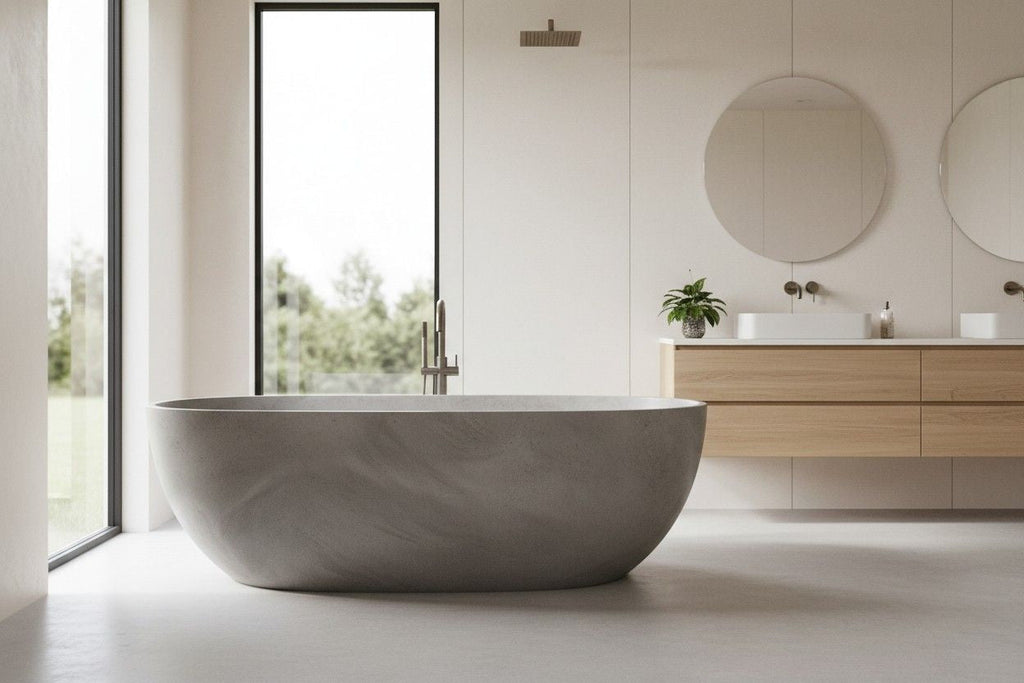
25
Mar
River Art Stone News & Blogs
The Material That's Changing How Architects Design Luxury Bathrooms
Read more
23
Jan
River Art Stone News & Blogs
Commercial Planters for US Offices: Boost Performance, Wellbeing, and Brand with Biophilic Design
Read more
17
Jan


