Spent three years recommending planters to landscape designers and hotel procurement teams before I understood why so many outdoor spaces looked off even after everything else was right. The problem was almost never the furniture or the plants. It was that nothing in the space had any real physical weight. One extra large planter, properly sized and the right material, fixes that faster than most things you can buy.
If you are shopping for something at the serious end of the scale, this is the guide. We are talking specimen trees, front entrances, commercial terraces, rooftop gardens. I will be direct about what to buy, what to skip and why the material conversation matters more than most people expect. Everything at River Art Stone ships free in the US.
So What Actually Counts as Extra Large?
24 inches wide or longer. 18 inches deep or more. That is roughly the threshold where a planter stops being a plant holder and starts doing real work in a space.
Here is the practical difference. A large planter handles one ornamental in a garden bed. An extra large one is what you reach for when the project is the space itself. Anchoring a hotel entrance. Giving a rooftop terrace a sense of enclosure. Making a commercial exterior look like someone actually thought about it. Below 24 inches, none of those things happen the way you want them to.
The other thing that changes past that size: material stops being a background decision.
The Material Question (And Why It Matters More Here Than You Think)
Most buyers do not want to spend time on this. Understandable. But a resin planter at this size, outdoors, in a state with real winters, filled with a tree — you are replacing it in 24 to 36 months. At that point whatever you saved upfront did not save you anything.
Quick breakdown of what is actually worth considering:
GFRC - Glass Fiber Reinforced Concrete: This is what River Art Stone uses and it is the right call for serious outdoor use. Frost-resistant. Does not fade. Roughly 60-70% lighter than poured concrete at the same dimensions, which matters enormously when you are placing on a deck or terrace. The finish on their modern pieces holds for decades without any treatment. On the antique finishes, the surface actually improves with age — develops a patina rather than just wearing down. Nothing to seal, nothing to repaint.
Poured concrete: Fine material but impractical at this scale. A 30-inch poured concrete planter can hit 200+ lbs before soil and plant. Good luck moving it if you change the layout. Not realistic on most terraces either.
Resin and fiberglass: Works fine indoors or under a covered structure. In direct outdoor sun, the surface degrades noticeably within a couple of seasons. The stone texture never quite convinces at close range whatever the product photos look like.
Ceramic and terracotta: If your property is in coastal California or South Florida and you genuinely never see frost, these are beautiful. Everywhere else — Chicago, New York, Denver, most of the Pacific Northwest — one hard winter is a real gamble at any price point.
Which Planters Are Actually Worth It
For trees and large ornamentals

Mondo Extra Large Round GFRC Planter
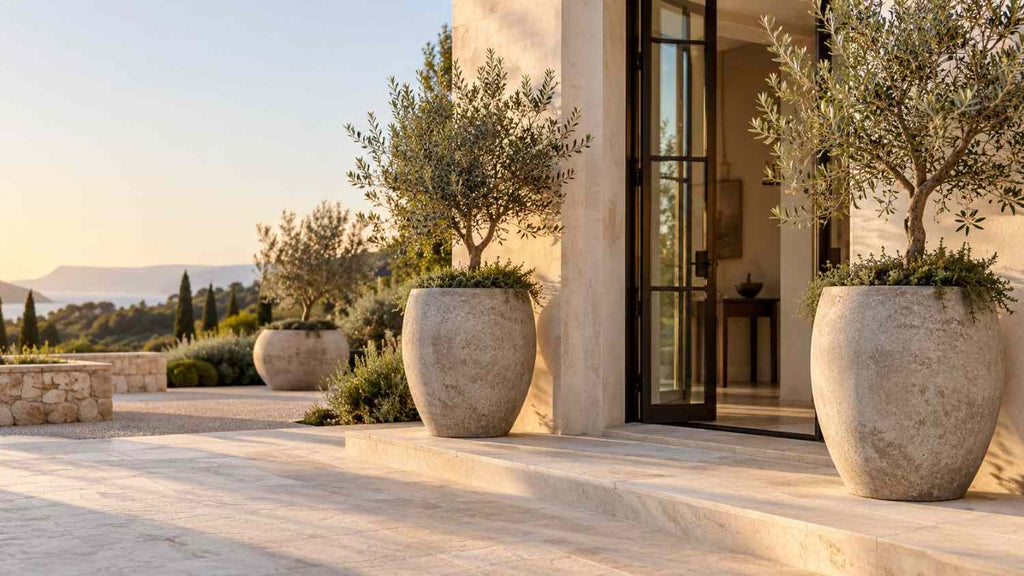
Most planters sold as “tree planters” are not wide enough for an established root system. The Mondo is. Wide-mouth round form, available in gray and olive, and genuinely designed around the fact that an olive tree or large ornamental needs room to establish rather than spiral. Two at a front entrance look deliberate. One in a garden border looks like something worth stopping to look at.
View Mondo Planter

Adalya Extra Large GFRC Green Planter
Green is the pick people talk themselves out of and then regret. Against red brick, natural stone or dark timber, this finish does something that gray cannot — it becomes part of the palette rather than just neutralizing against it. If you have a specific color story in the landscaping, the Adalya is the piece that makes it work at scale without looking like a garden center choice.
View Adalya Planter
For commercial spaces, hotels and contemporary homes

Hayyo Extra Large Modern GFRC Planter
Architects specify this one. Clean geometry without the coldness that some modern planters have — the matte gray reads well against steel, dark timber, glass and concrete without competing with any of them. The kind of piece that signals the space was designed rather than assembled.
View Hayyo Planter

Faddo Extra Large GFRC Black Planter
Black outdoor planters are everywhere and most of them disappoint in person because the material reads as plastic against natural stone or pale render. This does not have that problem. The matte GFRC finish holds its depth from a distance. Put it somewhere it will be seen, not tucked against a wall.
View Faddo Planter
For formal gardens, courtyards and traditional entries

Gobeklitepe Tall Antique GFRC Planter
The antique market is full of reproductions that look like reproductions. The Gobeklitepe does not the hand-cast surface has variation that only comes from the making process, not from a mold applied identically to every unit. The height is useful too. Brings plantings up to eye level rather than leaving a beautifully shaped topiary at shin height where nobody properly sees it.
View Gobeklitepe Planter
Modern vs Antique - How Most People Actually Decide
Your paving makes this call more reliably than your aesthetic preferences.
Contemporary hardscaping — concrete, composite, steel, clean render — suits modern planters. Sharp geometry, smooth finish, neutral tones. In those contexts they look resolved. Drop the same planter into a traditional stone or brick setting and it reads like it came from a different project.
Antique finishes have more range. They belong naturally in formal gardens and period properties, but one well-chosen antique piece in a contemporary setting often reads as intentional rather than confused. What they cannot survive is inconsistency around them — one good antique GFRC piece surrounded by resin pots in the wrong finish undermines itself completely.
If you genuinely cannot decide: match the planter finish to your exterior wall or paving. Works almost every time.
Before You Place the Order
Raised surfaces and weight: GFRC is the lighter option but filled with soil and a mature tree you are still looking at 150-300 lbs. Worth checking your deck or terrace load rating, particularly on upper floors.
Drainage: All River Art Stone planters have drainage holes. If you are placing on sealed stone or a rooftop, use feet or saucers underneath.
Depth by plant type: Trees want 18-24 inches of depth. Grasses, succulents and agave can work in shallower wide forms — depth matching root system matters more than matching plant height.
Timeline: Made to order. If you have a hard deadline — a hotel opening, a handover date on a renovation — contact the team early and build production time into your schedule.
All orders ship free anywhere in the US.
Frequently Asked Questions
What size planter do I actually need for an olive tree?
24 inches across minimum, 18-20 inches deep. The Mondo was designed with this in mind. Undersized and the roots circle, which limits how the tree develops long-term.
Do GFRC planters hold up in cold climates?
Yes. Frost-resistant, no cracking through freeze-thaw cycles. Works year-round across US climates without any treatment or winterizing.
How heavy are these when empty?
40-90 lbs depending on size. Add soil and a plant and you are at 150-300 lbs. Check load ratings on any elevated surface before ordering.
What plants do well in these?
Olive trees, ornamental grasses, agave, tall bamboo, ficus, large succulents. Match depth to root system. Trees need it. Grasses can manage with less.
Drainage holes — standard?
Yes, on all of them.
How long before I need to replace it?
20-30 years, realistically. Nothing to maintain. The surface develops rather than deteriorates.
Is shipping actually free?
Yes. All US orders.
What is a GFRC planter?
GFRC stands for glass fiber reinforced concrete. It combines concrete with glass fibers to create a planter that is lighter than poured concrete at comparable dimensions while retaining a stone-like finish.
Are extra large planters suitable for rooftops and terraces?
They can work on rooftops and terraces, but check the surface load rating before placing a filled planter. The combined weight of the planter, soil and plant can be substantial; use feet or saucers on sealed surfaces.