

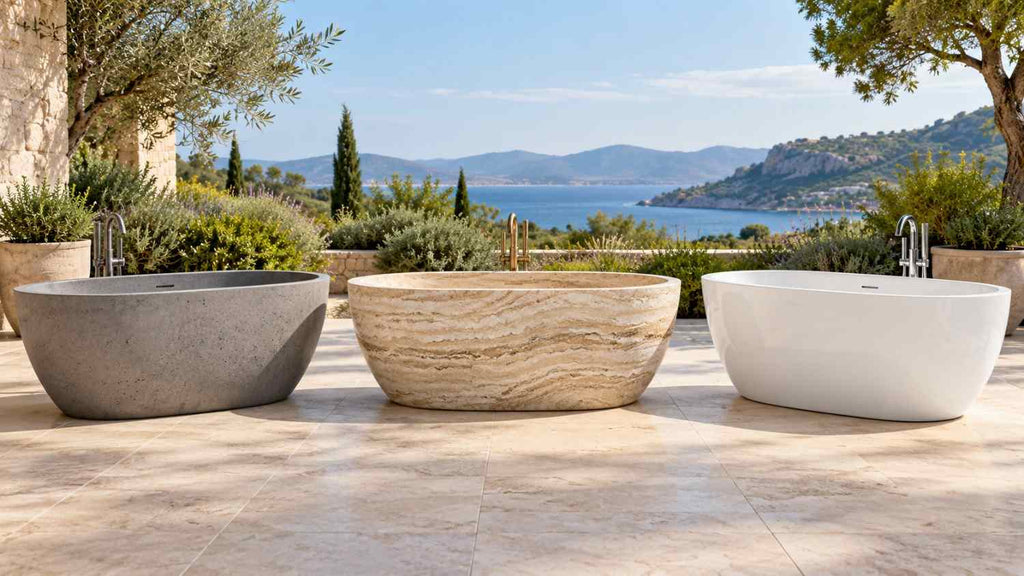
Concrete Bathtub vs Stone vs Acrylic: Which One Actually Lasts Outdoors?
Concrete Bathtub vs Stone vs Acrylic: Which One Actually Lasts Outdoors?
Here is the thing nobody tells you when you start shopping for an outdoor bathtub. The material decision matters about ten times more than it does for an indoor one, and most buyers figure that out too late usually after they’ve already ordered something that looks perfect in photos and falls apart after two winters.
I’ve seen this enough times to say it plainly: get the material right and you’re done. Get it wrong and you’re not just replacing a bathtub. You’re disposing of a cracked, faded one first.
This covers the three materials worth knowing about — concrete (specifically GFRC), natural stone and acrylic. All River Art Stone bathtubs ship free anywhere in the US.
Quick Comparison
| Feature | GFRC Concrete | Natural Stone | Acrylic |
|---|---|---|---|
| Frost resistance | Excellent | Poor to moderate | Poor |
| UV resistance | Excellent | Good with sealing | Poor |
| Weight | 150–250 lbs | 500–900 lbs | 60–120 lbs |
| Maintenance | None | Annual resealing | None |
| Outdoor lifespan | 20–30 years | Varies by climate | 5–8 years |
| Deck installation | Yes | Rarely practical | Yes |
What Outdoor Actually Means for a Bathtub
Indoors, a bathtub sits in a controlled environment. Temperature stays in a narrow range. Humidity is managed. UV exposure is essentially zero. The material requirements are pretty forgiving as a result.
Outdoors is another world. Depending on where you live, that bathtub will sit in direct sun for six to ten hours a day through summer. It’ll freeze in winter. It’ll expand and contract through daily temperature swings, get rained on, deal with humidity and then dry out completely. Most materials that work perfectly well inside start showing their weaknesses within a season or two of that.
The question to ask is not “what looks good?” It’s what holds up after three winters and four summers in your actual climate.
Concrete: Why GFRC Is Not What You’re Picturing
When people hear concrete bathtub, they usually picture something enormous and immovable. Dense, gray, 500 lbs. That’s poured concrete and it’s a real option — beautiful in the right setting but genuinely impractical for most outdoor situations. Deck installation is basically out. Moving it once it’s placed is not really a conversation worth having.
GFRC is different and worth understanding separately. Glass Fiber Reinforced Concrete. The glass fiber content changes the structural properties in ways that matter a lot outdoors: it’s 60 to 70% lighter than solid poured concrete at equivalent dimensions, which makes deck and terrace installation realistic. More importantly, it’s frost-resistant in a way poured concrete isn’t. Freeze-thaw cycles that crack and spall traditional concrete don’t affect it. UV doesn’t fade it. There’s no sealing schedule, no winter prep, nothing. You install it and leave it.
Realistic outdoor lifespan is 20 to 30 years. That’s not marketing language. It reflects what the material actually does when left outdoors year-round.
The other thing worth knowing: the surface on a quality GFRC concrete bathtub develops as it ages rather than degrading. Most outdoor materials look worse at year ten than year one. GFRC tends to look better.
#1. Cappadocia Concrete Bathtub

Hand-cast GFRC designed for outdoor use. The surface has variation that only comes from hand-casting — no two pieces land exactly the same way. Suits formal outdoor settings well: walled gardens, stone terraces, spaces where the bathtub is meant to anchor the scene rather than just sit in it. Works year-round across all US climates. Ships free.
#2. Gordion Bathtub

Same GFRC, cleaner geometry. If your outdoor space has a contemporary feel — concrete paving, minimal planting, dark timber or steel — the Gordion fits without visual friction. Looks specified rather than selected. Ships free anywhere in the US.
Natural Stone: The Part No One Talks About in the Listing
Stone bathtubs photograph exceptionally well. Marble, granite, travertine, lava stone — all of them look stunning in the kind of outdoor setting shots that show up on design sites. The outdoor performance story is more complicated and most sellers don’t get into it.
Natural stone is porous. Outdoors, that means it absorbs water. In climates with freezing winters, absorbed water expands inside the stone during freeze-thaw cycles. That’s how you get surface cracking, spalling and eventually structural damage. A stone bathtub in coastal Southern California where frost never happens will last decades. The same tub in Chicago or Boston or Denver is a real gamble.
Weight is the other problem. Natural stone bathtubs routinely come in at 500 to 900 lbs. Ground level on a solid concrete pad: manageable. On a deck, a raised terrace, anywhere with load rating concerns: usually not practical without serious structural work.
And maintenance is not optional. Natural stone needs resealing every one to two years outdoors to prevent water absorption and staining. Skip a season and the surface starts showing it.
For an indoor bathroom in a controlled environment, natural stone is genuinely excellent. Outdoors in most US climates, it asks more from you than most buyers expect.
Acrylic: It Works Until It Doesn’t
Acrylic is the most common indoor bathtub material in the US. Lightweight, affordable, easy to form. For indoor use in a temperature-controlled bathroom it’s perfectly fine.
Outdoors, UV exposure is the main problem. Acrylic yellows and chalks in direct sun. In a sunny outdoor installation most people see visible surface changes within two to three seasons — sooner than they expected when they bought it. Cold temperatures make acrylic brittle, which increases the risk of cracking through winter.
You will see products marketed as UV-resistant or outdoor-rated. Read the warranty language carefully before trusting those claims. Most cover manufacturing defects. They don’t cover UV degradation or weathering — which is exactly what fails in an outdoor installation.
Realistic outdoor lifespan in a four-season US climate: five to eight years before the surface condition is a problem. Full sun shortens that.
FAQ
1) What’s the best material for an outdoor bathtub?
For most US climates, GFRC concrete. Frost-resistant, UV-stable, no maintenance, 20 to 30 year outdoor lifespan. Natural stone works in frost-free climates but needs annual sealing and is vulnerable to cracking in cold weather. Acrylic degrades fastest in direct sun.
2) Can a concrete bathtub stay outside year-round?
Yes, if it’s GFRC. It handles freeze-thaw cycles without cracking and holds up in UV without fading. Drain the water before temperatures drop below freezing. The tub itself needs no winterizing.
3) How heavy is a GFRC concrete bathtub?
150 to 250 lbs depending on size. Practical for deck and terrace installation. Poured concrete runs 400 to 600 lbs or more and usually needs ground-level placement.
4) Can you put a stone bathtub outside?
In frost-free climates like Southern California, Arizona or Florida, yes. In climates with real winters, the porosity of natural stone makes freeze-thaw damage a genuine risk. Weight also limits where outdoor installation is practical.
5) Does an outdoor bathtub need maintenance?
A GFRC concrete bathtub needs none. No sealing, no coating, nothing. Natural stone needs resealing every one to two years outdoors. Acrylic is maintenance-free but degrades through UV exposure regardless.
6) How long does an outdoor concrete bathtub last?
20 to 30 years for a well-made GFRC piece with no maintenance. The surface develops character over time rather than showing wear.
7) Is shipping free?
Yes. All River Art Stone orders ship free anywhere in the US.
Related post

21
Oct
River Art Stone News & Blogs
Are GFRC Planters Worth It? Everything You Need to Know Before You Buy
Read more
21
Oct
River Art Stone News & Blogs
Concrete Bathtub vs Stone vs Acrylic: Which One Actually Lasts Outdoors?
Read more
20
Oct
River Art Stone News & Blogs
Best Extra Large Outdoor Planters for Trees, Entryways & Statement Spaces (2026 Guide)
Read more
21
May

25
Mar


